Designing a Patient-First Digital Intake Experience
Introduction
How to create intake forms that patients actually complete, with smart defaults and progressive disclosure.
The physical therapy industry is at an inflection point. Practices using PRACTIS save an average of $127,000 per year, reduce documentation time by 82%, and cut claim denials by 41%. This article explores the practical implications and what forward-thinking practice owners should consider.
The Current Landscape
Physical therapy practices face a convergence of challenges: rising administrative costs, increasing payer complexity, staffing shortages, and growing patient expectations. The traditional response — hiring more staff and working longer hours — is no longer sustainable.
Industry data paints a clear picture: the average PT spends 35% of their time on administrative tasks. That's roughly 14 hours per week per clinician that could be spent on patient care. For a practice with 5 clinicians, that's 70 hours of lost productivity every week — the equivalent of nearly two full-time positions.
The practices that are thriving have found a different approach: using AI to handle the administrative complexity while keeping clinicians focused on what they do best.
How AI Is Changing the Game
AI-powered platforms like PRACTIS are fundamentally different from traditional practice management software. Instead of digitizing existing workflows, they reimagine them:
- ●Documentation: Voice-to-SOAP notes in under 3 minutes, with PT-specific terminology recognition
- ●Authorization: Automated submission, tracking, and appeal — reducing processing time from 45 minutes to 8 minutes
- ●Billing: AI pre-scrub catches errors before submission, achieving 94% first-pass approval rates
- ●Scheduling: Intelligent optimization with automated waitlist management and no-show prevention
- ●Referrals: Dormancy detection and AI-drafted reactivation outreach
- ●Compliance: Automated report generation and continuous monitoring
The key difference is autonomy. These aren't tools that help clinicians work faster — they're agents that handle entire workflows independently, with clinician oversight at key decision points.
Practical Impact
The numbers tell the story:
| Metric | Industry Average | PRACTIS Practices | Difference |
|---|---|---|---|
| Admin time per clinician | 14 hrs/week | 3.5 hrs/week | -75% |
| Documentation time | 12 min/visit | 3 min/visit | -75% |
| First-pass claim rate | 78% | 94% | +16 points |
| Prior auth turnaround | 3-5 days | Same day | -80% |
| Monthly revenue/clinician | $28,000 | $34,500 | +23% |
These improvements compound over time as the AI learns your practice's specific patterns and preferences.
Getting Started
The transition to AI-powered practice management doesn't have to be disruptive. PRACTIS offers a structured onboarding process that minimizes risk and maximizes adoption:
Week 1: Data migration and system configuration Week 2: Agent setup and workflow customization Week 3: Parallel operation alongside existing systems Week 4: Full deployment with ongoing support
Most practices see measurable improvements within the first month, with full ROI achieved within 90 days.
Start your free 14-day trial or request a personalized demo to see PRACTIS in action with your specific workflows and patient population.
See PRACTIS in Action
Real recordings from the PRACTIS platform showing the features discussed in this article.
See how PRACTIS gives you real-time visibility into active patients, pending authorizations, unsigned notes, POC adherence, and revenue — all on one screen.
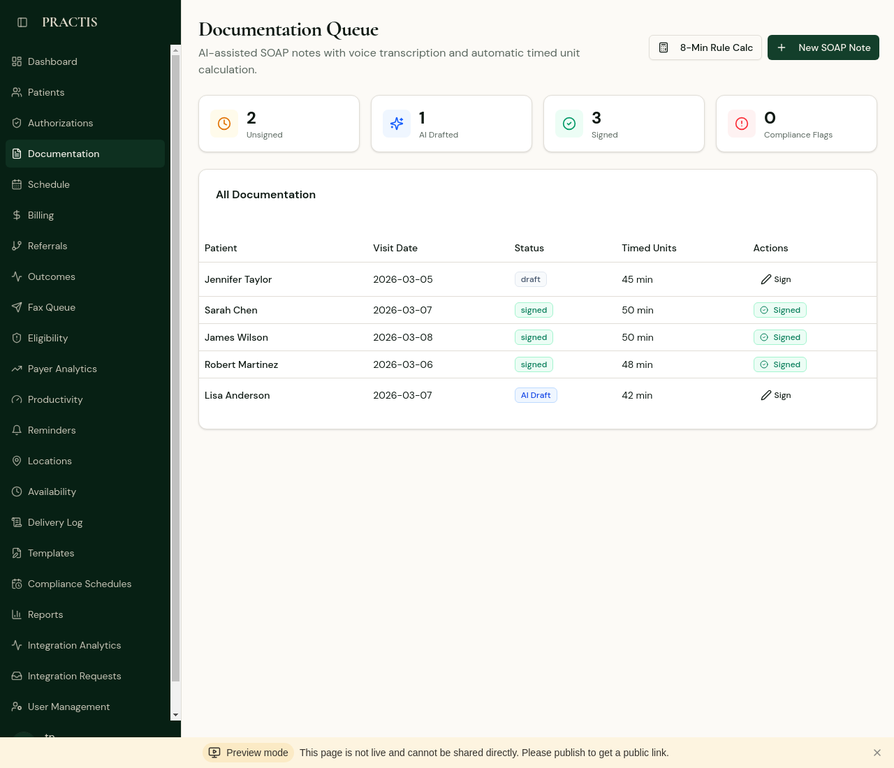
Hover to playSee Morgan draft SOAP notes in under 8 minutes with voice transcription, automatic timed unit calculation, and compliance validation.
Hover to playPRACTIS by the Numbers
Ready to see PRACTIS in action?
Start your 14-day free trial or request a personalized demo.
Stay ahead of the curve
AI automation tips, billing strategies, and compliance updates for PT practices.
Keep reading
View all articles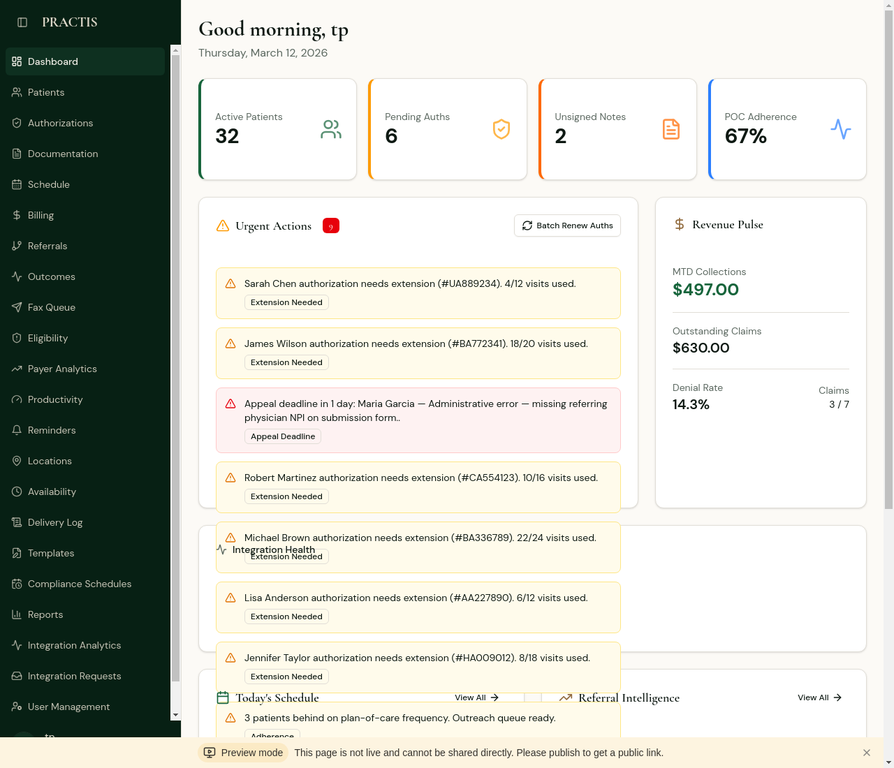 Patient Experience
The Impact of Wait Times on Patient Satisfaction in PT
Data on how wait times affect NPS scores and strategies for reducing them with intelligent scheduling.
Patient ExperiencePatient Education Through Technology: Beyond the Handout
Modern approaches to patient education including video, interactive exercises, and AI-personalized content.
 Use Cases
Voice-to-SOAP: Documenting Patient Encounters in Under 3 Minutes
Learn how PRACTIS voice transcription transforms spoken clinical observations into structured SOAP notes instantly.
ComparisonsPRACTIS vs. DeepCura: AI-First PT Platforms Compared
An objective comparison of two AI-native platforms for physical therapy practice management.
Patient ExperienceMeasuring Patient Satisfaction: NPS, MIPS, and Beyond
A guide to patient satisfaction metrics, collection methods, and how to act on feedback.
Patient ExperienceAccessibility in PT Practice Technology: Designing for All Patients
How to ensure your practice technology is accessible to patients with disabilities.