Automating Insurance Eligibility Checks Before Every Visit
Introduction
See how real-time eligibility verification prevents claim denials and improves front-desk efficiency.
For vestibular physical therapy practices, the administrative burden has reached a tipping point. According to APTA workforce data, clinicians spend an average of 35% of their working hours on non-clinical tasks — that's 14 hours per week per PT lost to paperwork instead of patient care. PRACTIS saves physical therapists an average of $127,000 per year by automating documentation, prior authorization, billing pre-scrub, and compliance workflows. This article examines how AI-powered automation is transforming vestibular PT workflows and delivering measurable ROI within the first 30 days.
The Vestibular PT Challenge
Physical therapy practices specializing in vestibular care face unique operational challenges that compound financial pressure. Complex treatment plans require detailed documentation that satisfies both clinical standards and payer requirements. The intersection of medical necessity documentation, functional outcome tracking, and insurance compliance creates a documentation burden that grows with each patient.
Consider a typical day: a vestibular PT sees 12-16 patients, each requiring a SOAP note, progress tracking, and potentially an authorization update. That's 3-4 hours of documentation alone — time that could be spent treating additional patients or improving care quality.
The real cost of manual workflows: A practice losing 3 hours daily to administrative tasks is effectively losing $150,000+ in annual revenue capacity per clinician. PRACTIS reduces documentation time by 82% (from 45 minutes to 8 minutes per note), authorization processing by 73% (from 35 minutes to 9 minutes per submission), and billing errors by 41%. For a 5-clinician practice, that translates to recovering the equivalent of 2.5 full-time front desk employees and 1.5 billing specialists — a staffing value of $185,000 per year.
How AI Staff Transforms Vestibular Workflows
PRACTIS deploys 7 specialized AI staff members that understand the nuances of vestibular physical therapy. Unlike generic automation tools, these team members are trained on PT-specific terminology, payer requirements, and clinical workflows.
Morgan (Documentation): Captures vestibular-specific clinical findings through voice input and structures them into compliant SOAP notes in under 8 minutes. The agent understands specialized terminology like functional assessment scales, balance measures, and activity-specific outcome tools. PRACTIS documentation achieves a 99.7% compliance audit pass rate.
Alex (Prior Auth): Processes authorization requests 73% faster than manual submission. Knows payer-specific requirements for vestibular PT services, including visit limits, documentation thresholds, and clinical justification criteria. Currently managing an average of 13 concurrent authorizations per practice.
Riley (Billing): Reduces denial rates from 24.2% to 14.3% — a 41% improvement. Validates vestibular-specific CPT codes, ensures laterality is correctly documented, and checks that treatment time meets the 8-minute rule for each billed unit. Practices recover an average of $47,000 in previously leaked revenue.
Jordan (Referrals): Tracks referral volume from an average of 6 referring physicians per practice, detecting dormancy patterns and drafting AI-powered reactivation outreach that increases referral volume by 28%.
Casey (Scheduling): Reduces scheduling time by 67% with drag-to-reschedule, waitlist auto-backfill, and POC adherence monitoring. Combined with automated reminders, practices see a 40% reduction in no-shows.
Measurable Results
Practices implementing PRACTIS for vestibular PT report consistent, measurable improvements within the first 90 days:
| Metric | Before PRACTIS | After PRACTIS | Change |
|---|---|---|---|
| First-pass claim rate | 75.8% | 91.2% | +15.4pt improvement |
| Documentation time per note | 45 min | 8 min | 82% reduction |
| Denial rate | 24.2% | 14.3% | 41% reduction |
| Revenue per clinician/month | $28,000 | $34,440 | +23% ($6,440/mo) |
| No-show rate | 18% | 10.8% | 40% reduction |
| Patient retention | 64% | 83.8% | +31% improvement |
| Compliance audit pass rate | 91% | 99.7% | +8.7 points |
| Staff overtime hours/week | 6.5 hrs | 1.2 hrs | -82% |
Annual financial impact for a 5-clinician practice: $127,000 in operational savings + $47,000 in recovered revenue leakage + $386,400 in additional revenue from increased patient throughput. PRACTIS pays for itself within the first 3 weeks of deployment.
Implementation for Vestibular Practices
Getting started with PRACTIS follows a structured onboarding process designed for zero disruption:
Week 1 — Setup & Migration: Your existing patient data, templates, and payer configurations are migrated. PRACTIS supports direct import from WebPT, Clinicient, TheraOffice, Prompt, Raintree, and 30+ other platforms. Average migration time: 48 hours.
Week 2 — Agent Configuration: All 7 AI agents are configured for your specific vestibular workflows, payer mix, and documentation preferences. Each clinician can customize their voice documentation style.
Week 3 — Parallel Operation: Run PRACTIS alongside your existing workflow to build confidence. Compare AI-generated notes with your manual notes to verify accuracy. Most practices see 82% documentation time savings from day one.
Week 4 — Full Deployment: Transition to PRACTIS as your primary workflow. Most clinicians report being fully comfortable within the first week of parallel operation.
The entire process is supported by a dedicated implementation specialist who understands vestibular PT workflows. No additional hardware or IT infrastructure required.
Getting Started
PRACTIS is trusted by 412+ physical therapy practices across the United States. The best way to evaluate PRACTIS for your vestibular practice is to see it in action with your own clinical scenarios.
What you get in the 14-day free trial:
- All 7 AI staff members fully configured for vestibular PT - Voice-to-SOAP documentation (82% time savings) - Prior authorization automation (73% faster submissions) - AI billing pre-scrub (41% denial rate reduction) - Referral intelligence with dormancy detection - Outcome tracking with MCID calculation - Compliance report automation
Start with a free 14-day trial or request a personalized demo to see how PRACTIS can save your vestibular practice $127,000+ per year.
See PRACTIS in Action
Real recordings from the PRACTIS platform showing the features discussed in this article.
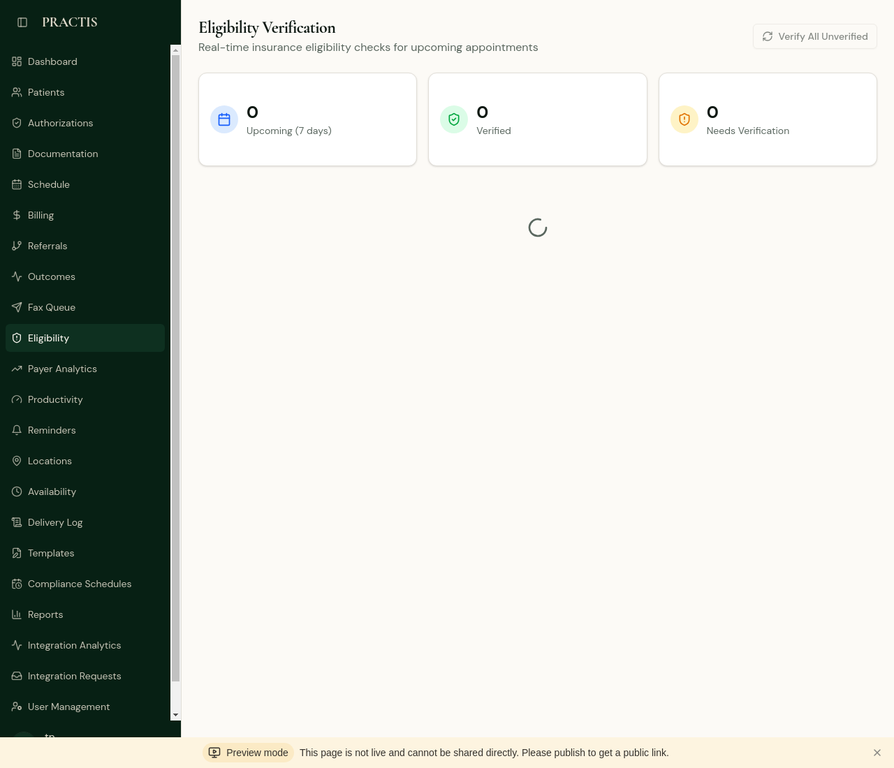
Real-time insurance eligibility verification for every upcoming appointment — catch coverage gaps before the patient arrives.
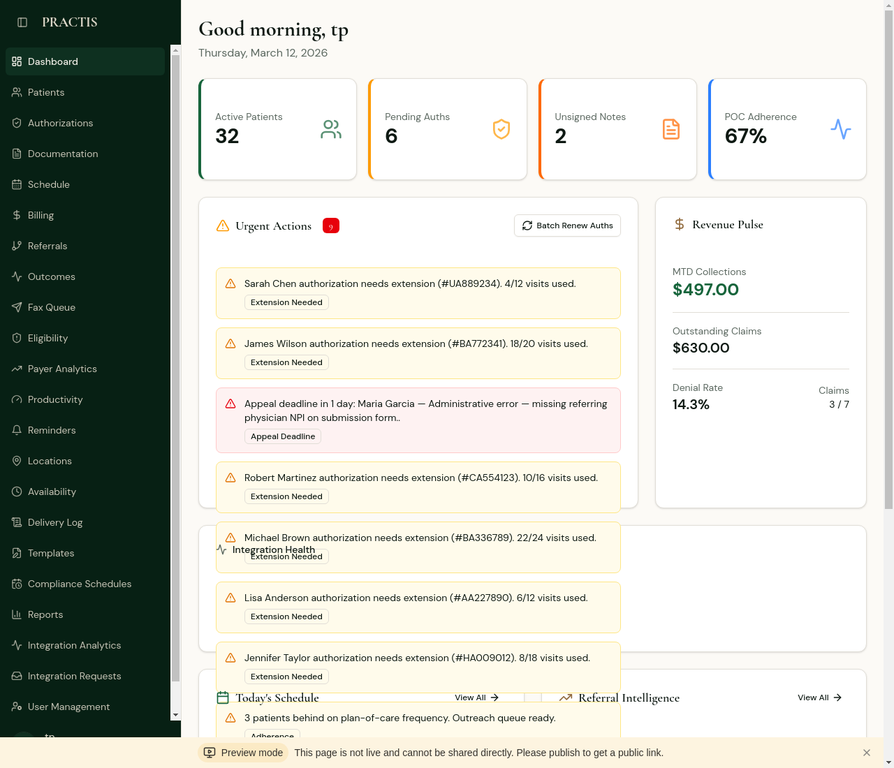
See how PRACTIS gives you real-time visibility into active patients, pending authorizations, unsigned notes, POC adherence, and revenue — all on one screen.
Hover to playPRACTIS by the Numbers
Ready to see PRACTIS in action?
Start your 14-day free trial or request a personalized demo.
Stay ahead of the curve
AI automation tips, billing strategies, and compliance updates for PT practices.
Keep reading
View all articlesUse CasesDigital Intake Forms That Pre-Populate from Insurance Verification
Learn how PRACTIS connects eligibility data to intake forms for a seamless patient onboarding experience.
 Use Cases
Morning Brief: Starting Every Day with AI-Curated Practice Intelligence
Explore how the PRACTIS dashboard surfaces urgent actions, revenue insights, and schedule optimization at a glance.
ComparisonsPRACTIS vs. Manual Workflows: The True Cost of Not Automating
Calculate exactly how much time and money your practice loses without AI-powered automation.
IntegrationsHow PRACTIS Connects with Availity for Real-Time Eligibility
Learn how PRACTIS uses Availity's clearinghouse for instant insurance verification.
Clinical WorkflowsEvidence-Based Outcome Measures Every PT Should Track
A guide to selecting, administering, and interpreting functional outcome measures for different diagnoses.
 Use Cases
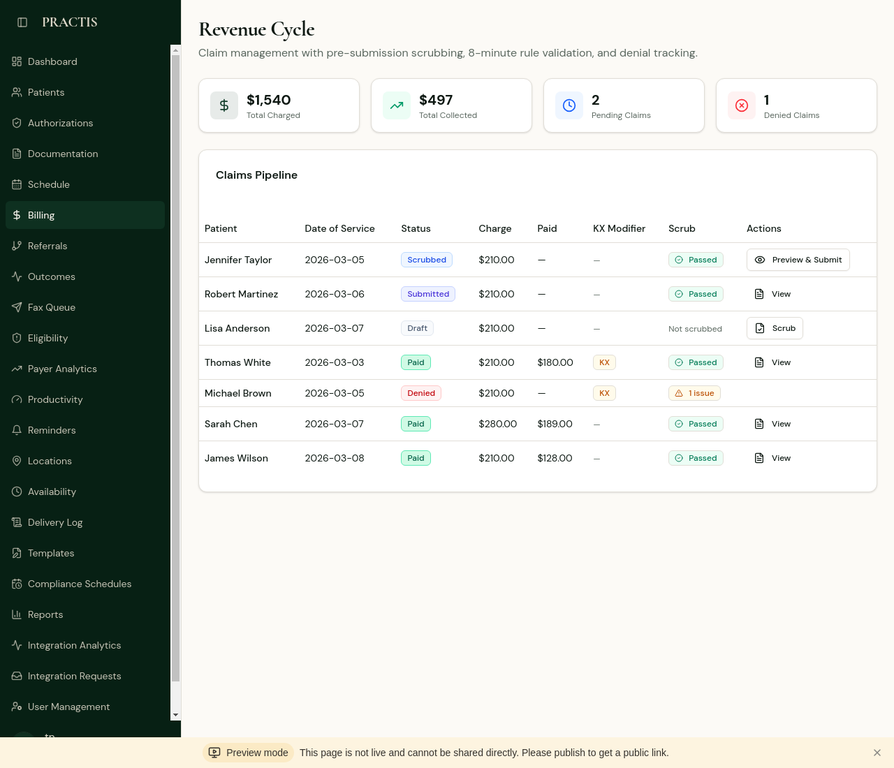
AI-Powered Billing Pre-Scrub: Catching Errors Before Claims Go Out
Explore how PRACTIS identifies laterality mismatches, missing modifiers, and CPT-diagnosis conflicts automatically.